Knee, shoulder and hip arthroscopy in Athens
Knee, Shoulder & Hip Arthroscopy
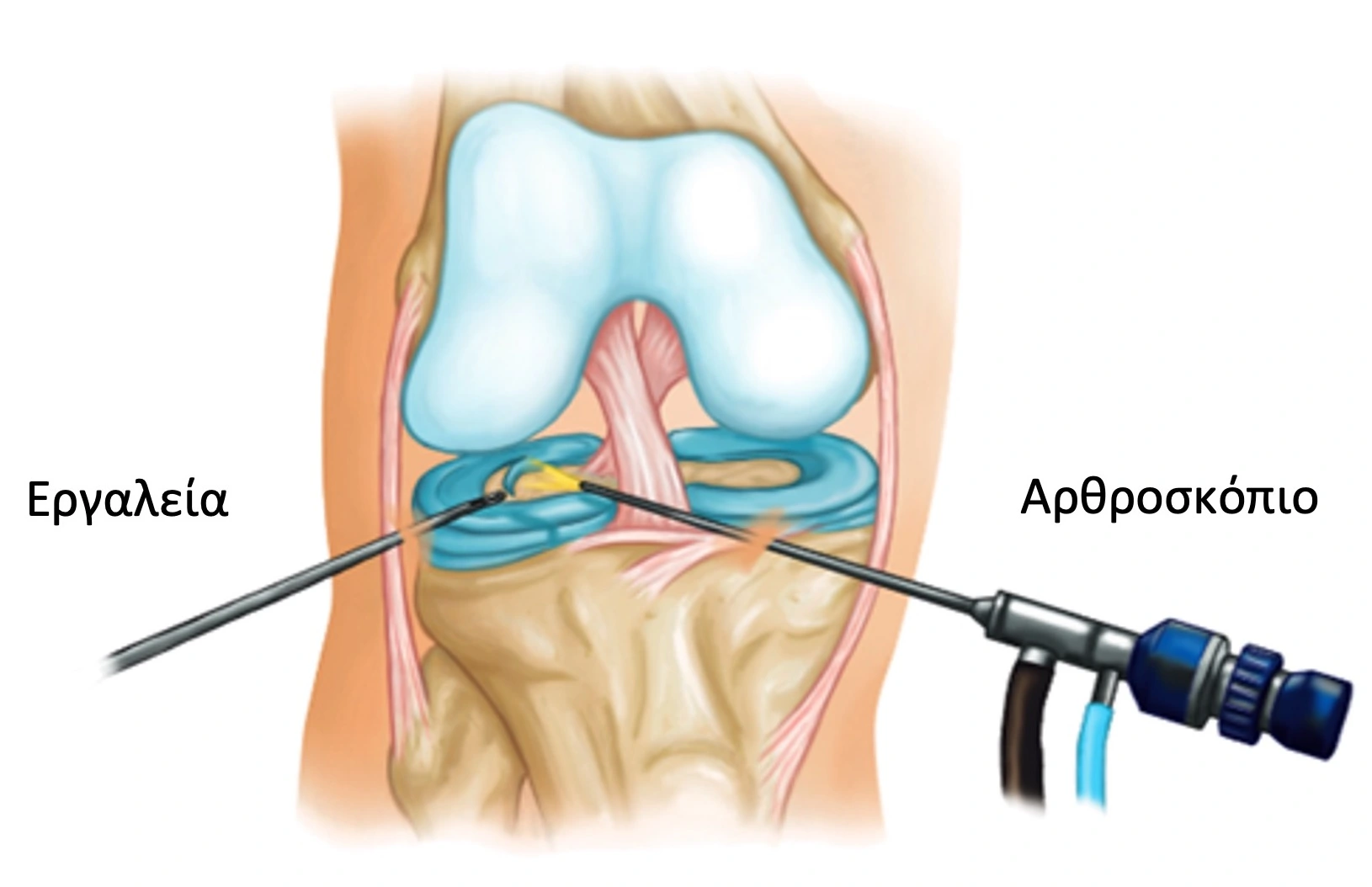
Arthroscopy is a minimally invasive technique for diagnosing and treating joint damage through small incisions.
Dr. Stavros Alevrogiannis , a Specialized Orthopedic Surgeon, applies modern arthroscopic methods to the knee, hip and shoulder with the aim of rapid recovery and safe return to activities.
Knee Arthroscopy
Knee arthroscopy is used to treat injuries and diseases:
- Meniscus tear
- Cruciate ligament rupture
- Cartilage lesions
- Inflammation or chronic pain, depending on the diagnosis
Advantages:
- Small incisions
- Reduction of postoperative pain
- Faster mobilization
What is arthroscopy?
With a special camera and micro-tools, the doctor sees and corrects damage within the joint without a large incision. It is often performed as a day procedure , with minimal pain and rapid mobilization.
Which joints is it applied to?
Knee: meniscus tear , cartilage damage, meningitis syndromes
Shoulder: supraspinatus/rotator cuff tear , shoulder instability, SLAP
Other joints: elbow, ankle (as appropriate)
Shoulder arthroscopy
Shoulder arthroscopy is used for various conditions:
Myotendinous pad rupture
Recurrent shoulder dislocation
Impact syndromes
Calcific tendonitis
By using an arthroscope, the surgeon restores joint function with greater precision, limiting postoperative pain.
Hip Arthroscopy
Hip arthroscopy allows minimally invasive access to deep joints, where classical methods are more difficult. It is used for:
Impact syndromes
Labial cartilage rupture
This technique reduces complications and offers a faster return to daily activities.
Why choose arthroscopy?
Minimally invasive : small incisions, less tissue damage
Faster recovery : patients are mobilized immediately
Accuracy of diagnosis & treatment thanks to the high-resolution camera
Reduced pain & fewer complications
Indications – When do we recommend it?
Persistent pain/joint locking
Failure of conservative treatment (physical therapy/medication)
Mechanical symptoms (clicking, “locking”)
Sports injuries (cruciate/meniscus/shoulder)
Why choose Dr. Stavros Alevrogiannis
- Many years of experience in arthroscopic knee/shoulder surgery
- Minimally invasive philosophy & rapid recovery protocols
- Personalized recovery guidance
Arthroscopy describes access as well as the work inside a joint
Arthroscopy explains how a surgeon can see and work inside a joint. It does not by itself describe one particular treatment. The actual procedure may involve different tissues and have different requirements afterwards. Information should therefore begin with the diagnosis and intended objective. Ask what would be done, why it is proposed and which alternatives have a place. A small incision is a feature of access rather than a complete explanation of outcome, recovery or suitability for every knee, shoulder or hip symptom. Understanding the exact intervention makes comparison and preparation more useful than relying on a general surgical label.
Diagnosis comes before selecting a technique
Discussion of an operation follows history, examination and appropriate investigations. Pain, swelling or catching need assessment and do not alone determine the same procedure for everyone. Bring images, reports and information about earlier care. Ask which findings relate to your functional difficulty. If another investigation is proposed, understand which question it would answer. Choosing arthroscopy should be explained in relation to the diagnosis rather than selecting a technique first and then finding a broad reason to use it. Mention changes since earlier investigations, especially another injury or a new limitation not present when those images were obtained.
Meniscus and ACL procedures have different knee objectives
The meniscus tear page explains choices that differ from those discussed for an ACL tear. Associated injuries may nevertheless need one overall strategy. Ask for repair, removal of a limited portion and ligament reconstruction to be distinguished. Arthroscopic knee operations do not all have the same walking or return programme. Appropriate information describes everything proposed and how it affects rehabilitation. This helps explain why another patient's programme may not apply even if they also had arthroscopy. Ask how details of combined procedures will be communicated to the professionals involved in recovery.
Cartilage lesions require a precise description
A general reference to cartilage does not explain position, extent or treatment objective. If an intervention is proposed, distinguish it from work on a meniscus or ligament. Cartilage restoration and scaffolds or membranes have their own requirements. Arthroscopic access does not mean every method is appropriate for every joint or form of wear. Uncertainty also belongs in the discussion. You can then compare actual treatment plans rather than assuming that all small-incision procedures are equivalent. Ask which structure is being treated and how this affects instructions for protection, movement and progression afterwards.
Shoulder repair differs from stabilisation
A rotator cuff tear concerns a different problem from recurrent shoulder dislocation. One discussion may focus on a tendon and the other on structures contributing to stability. The actual diagnosis determines the proposal and postoperative protection. If several findings are present, ask which would be treated and why. Small incisions do not mean immediate permission for every movement, load or sport. A personal programme and explanation of stages are needed so that daily use follows the actual operation's instructions. Understanding these differences also helps you prepare practical support at home rather than expecting a single recovery plan for all shoulder arthroscopy.
Shoulder pain is not the same as an indication for decompression
Shoulder impingement symptoms need assessment and careful discussion of evidence. Persistent pain alone does not automatically establish a reason for subacromial decompression. That procedure should be distinguished from a different indication such as tendon repair. If arthroscopy has been proposed, ask what exactly is intended and why it is appropriate for the diagnosis. Naming the approach is insufficient to bypass questions about benefit and alternatives. The impingement page provides related information and distinguishes different treatment questions. Use it to prepare a discussion rather than assume that a broad shoulder pain label determines the procedure.
The overall hip context matters
A hip labral lesion, femoroacetabular impingement and arthroscopic hip debridement need separate explanations. They are not different names for one universal operation. Ask what the proposed plan concerns and how joint condition is considered. If osteoarthritis is the principal problem, arthroscopic lavage or debridement is not recommended as its general treatment. Information should distinguish a specific indication from an expectation of renewing the hip. Alternatives follow the diagnosis rather than only a wish for a smaller incision. Ask which symptoms the proposal aims to affect and what limitations may remain despite treatment.
Nonsurgical care and reassessment before deciding
Where care without an operation is appropriate, you need a clear objective, instructions and a way to review response. Explain earlier treatment, its duration and changes in daily function. Saying only that you had physiotherapy does not describe the programme or its results. Mention practical difficulties that prevented following instructions. If surgery is proposed, ask why it is appropriate at this point. A decision needs information about benefits, limitations, risks and rehabilitation requirements rather than relying only on longstanding symptoms. Agree how progress will be assessed and which changes would prompt reconsideration of the proposed direction.
What the team needs before planned arthroscopy
Assemble medication, allergies, important health conditions and earlier operations. The responsible professionals will determine preoperative investigations, anaesthetic assessment and personal instructions. Do not change treatment independently. Ask when to attend and which documents to bring. Mention other medical follow-up so instructions are clear. Length of stay and support needs are not assumed identical for everyone. Preparation follows the planned procedure and general health rather than one list for every joint. Raise concerns about instructions early, particularly if another condition or treatment makes a general explanation difficult to apply in your circumstances.
Organise the return home practically
Discuss transport, accompaniment where required and help with basic needs. Stairs and walking aids may matter after a lower limb procedure, while shoulder surgery can affect tasks involving both hands. Tell the team if you live alone or care for someone else. Request a practical explanation of instructions before leaving the clinic. The plan must be feasible in your actual circumstances. Preparation does not remove restrictions, but reduces the need to improvise unapproved movements to meet an ordinary responsibility. If someone will assist you, arrange for relevant practical instructions to be understood with your agreement.
Rehabilitation follows the tissues treated
Skin healing does not describe the whole internal recovery. Repair, reconstruction or another procedure may involve particular movement and loading limits. Ask for a written programme and clear communication with the physiotherapist. Find out what will be assessed before demands increase. You do not need to accelerate the programme independently because you feel better or compare yourself with another patient. Report difficulties and changes. Functional progression is discussed within the personal plan and reviews, based on the actual operation. Keep questions about unclear instructions for the responsible team rather than combining different programmes from unrelated sources.
Work, driving and sport are separate decisions
Desk work, prolonged standing, manual duties and contact sport have different demands. Describe actual movements and your travel arrangements. Driving needs individual advice about function, safety and medication. Within sports medicine follow-up, return planning concerns a particular goal and functional criteria. General time ranges do not provide personal clearance. Ask who assesses readiness and how limited participation is distinguished from full return. A decision should not depend only on a calendar or absence of pain. Explain commitments in advance so that practical adjustments and realistic priorities can be discussed alongside the clinical plan.
Understanding arthroscopy costs in Athens
Cost should match the joint and actual procedure rather than a broad title. An estimate needs information about hospital charges, anaesthesia, professional fees, materials or grafts where needed and reviews. Combined procedures should be clarified. Physiotherapy, supports and travel may be accounted for separately. Confirm insurance contributions for your own plan. A fixed universal price would equate different operations incorrectly. Detailed information helps you understand coverage and plan for the whole care pathway, including rehabilitation needs. Ask which services are arranged separately and how a change to the proposed procedure would be reflected in the estimate.
Safety, monitoring and subsequent decisions
Arthroscopy remains a surgical procedure with possible risks and uncertainties. Request an explanation for your circumstances and find out which postoperative symptoms need prompt contact. Small incisions do not mean zero risk or a guaranteed result. At review, discuss activities that changed and those still difficult. If progress differs from the original plan, assessment is needed before another treatment decision. Repeating a procedure is not an automatic next step. Continuing care needs clear reasoning, available instructions and a shared understanding of your course. Specific observations about daily tasks help the discussion more than comparison with someone else's recovery.
Make the consultation useful for your decision
Before the visit, write down the main functional difficulty and questions affecting your choice. Aim to describe the diagnosis, proposed procedure and rehabilitation in ordinary language after the discussion. Arrange someone to help record information if that is your preference. Bring earlier proposals so specific differences can be compared. Technical terminology is unnecessary for expressing concern. Personal information requires time for questions and discussion of real needs rather than treating the decision as already made. Ask for clarification where the explanation does not show why a particular approach fits your diagnosis or how you would follow the plan afterwards.
Arrange an arthroscopic assessment in Cholargos
For a consultation with Dr. Stavros Alevrogiannis, use the contact page and confirm the appointment at Metropolitan General, 264 Mesogeion Avenue, Cholargos. Explain which joint concerns you and which records are available. Examination provides the basis for discussing appropriate treatment, rehabilitation and cost. It does not imply that arthroscopy is needed. The aim is understanding the cause of difficulty and a proposed plan, with clear next steps and space for personal questions. Confirm useful documents and practical arrangements before travelling, particularly if earlier treatment or imaging took place elsewhere.
Further information: AAOS: arthroscopy and NICE: arthroscopic procedures and osteoarthritis. Individual condition pages explain more specific choices.
Frequently Asked Questions (FAQ)
Minimally invasive technique that allows diagnosis/correction of damage within the joint through small holes.
With modern techniques, pain is mild and controlled; most patients become mobile on the same day.
What to discuss before arthroscopy
The decision to have knee, shoulder or hip arthroscopy begins with the clinical examination and available findings. Describe when the pain occurs, if there is instability or limitation of movement, and what activities you want to do again. Previous tests and information about medication help prepare for the visit.
Ask what damage is being treated, what other options are available, and what support you will need after the procedure. Rehabilitation varies depending on the joint and the procedure to be performed. For your estimate in Athens, at 264 Mesogeion St., Cholargos, see the contact page .

THE PATIENT IS AT THE CENTER
Collaboration & Support, Our Basic Principles