Vima interview: MATRIX knee and hip arthroplasty
- Dr. Stavros Alevrogiannis
- Orthopedic information
- MATRIX arthroplasty: interview with “Vima”
MATRIX knee and hip replacements
When fantasy and reality meet in science
Additional reader note: References in the interview to absolute safety, implant longevity or immediate return require individual clinical interpretation. They are not outcome guarantees. See the additional treatment and recovery guide following the interview.
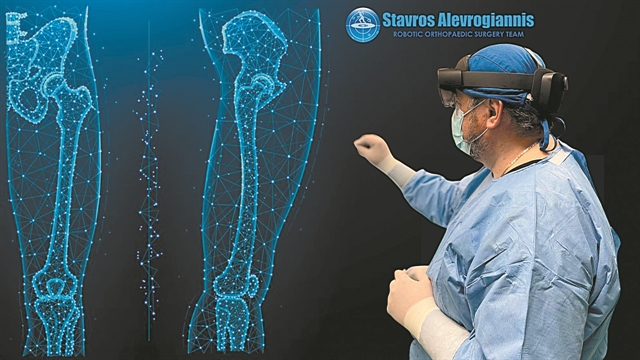
Cutting-edge technology, MATRIX technology, surpasses robots and combines three-dimensional calculation in the operating room through special glasses, surgical sensors and invasive software that reaches the ultimate in safe placement of prosthetic materials in patients with severe arthritis, ensuring full mobility of the joint immediately postoperatively and longevity of over 30 years.
Techniques from the future
Dr. Stavros Alevrogiannis, Director of Robotic Arthroplasty of the Knee and Hip at METROPOLITAN GENERAL, explains the tools of digital reality in orthopedics and the digitization of total knee and hip replacements in Europe and America.
With special motion sensors, the surgeon becomes the ‘robot’ that precisely performs each surgical action. MATRIX arthroplasties are an evolution of the software used by existing robotic systems, guiding the surgeon rather than a mechanical arm. Virtual reality glasses are used with software comparable to that of the most advanced robotic systems.
It is no coincidence that these arthroplasties were named MATRIX: they really are joint replacement techniques that have arrived in the present from the future.
Why choose MATRIX?
Because patients should place their trust first in the surgeon’s experience and scientific training.
Because the surgical tools should be in the surgeon’s hands.
Because patients should be certain about the type of operation they will undergo and receive the corresponding certification file.
Because not all patients have the same needs and functional requirements.
Because the MATRIX technique is compatible with all types of knee and hip implants.
So, for a young 45-year-old patient seeking longevity, a 60-year-old seeking function, or a 90-year-old needing immediate mobilization, we can select an individualized type, quality, weight and durability of prosthetic material. The patient’s anatomy and requirements should determine the prosthetic material.
That the operation is bloodless and very fast, and that the patient gets up immediately, walks and returns home straight away, is a given.
With special motion sensors, the surgeon becomes the ‘robot’ that precisely performs each surgical action. MATRIX arthroplasties are an evolution of the software used by existing robotic systems, guiding the surgeon rather than a mechanical arm. Virtual reality glasses are used with software comparable to that of the most advanced robotic systems.
It is no coincidence that these arthroplasties were named MATRIX: they really are joint replacement techniques that have arrived in the present from the future.
The patient's participation
We must emphasize that not all orthopedic surgeons perform robotic operations, such as robotic knee replacement for the simple reason that they have not received appropriate training, lack the required experience or certification, cannot manage the operating time, or work in a clinic without a robotic system.
The same applies to the length of hospitalization. A 50-year-old patient without other conditions may indeed be discharged safely on the same day, a few hours after surgery. However, the average patient is over 65 and takes long-term medication (painkillers, anti-inflammatory or blood pressure medication). This is the everyday patient who wants to leave without pain, standing, able to care for themselves and without placing a burden on their family. This patient comes to us to be cared for. They will therefore stay in our clinic for 1–2 days, depending on their needs, take their medication, ask their questions, receive instructions and gait training, and leave smiling and safe.
At our clinic, patients are informed about the surgical technique, implant quality, compatibility with any allergies and its non-magnetic properties. This addresses the concerns of patients who need MRI scans for other conditions (the materials are non-magnetic), have a pacemaker or undergo hemodialysis.
Through special glasses, patients can also see a three-dimensional image of the damage to their joint, the preoperative plan and the postoperative result. They know the process ahead and soon forget the prosthetic material, as it quickly becomes a natural part of their body. As for the stitches in the small incision, they fall out on their own and do not need removal.
Implant placement
The surgeon’s ability to receive knowledge extremely quickly, use it during the operation and operate in a virtual reality environment leads to the ultimate result in total knee or hip replacement.
Nothing can go wrong when the digital image of the bone is matched to our own joint, using a three-dimensional knee or hip model that will function better than our biological joint for at least 30 years.
Thanks to unique algorithms based on artificial intelligence, a simple camera installed in ‘smart glasses’ operates beneath the skin, identifies objects in three-dimensional space with millimeter precision and reconstructs them into a virtual three-dimensional bone model, aligning them with the actual bone.
It is truly impressive how quickly, and above all safely, an arthroplasty can be performed: within 30 or 40 minutes, the surgeon has corrected every area of joint damage and given the patient a bone of better quality than their biological one.
The most important part is that the implants are positioned during surgery by aligning the limb’s mechanical load axis to the angles at which it should function normally.
We have measurements while we operate. The surgeon’s hands function as sensors, because they are guided by the software and the surgeon, through special 3D imaging glasses, moves the graft to touch it where it organically belongs.
We will never worry about whether it was placed correctly, whether it works properly, whether it supports our walking, our exercise, our manual fatigue.
It is indicated in patients with cardiac and pulmonary diseases, in patients with particularly high body weight and in patients of advanced age. The MATRIX technique is the technique that all surgeons will follow for the next decades at least.
From the MATRIX presentation to a personal care plan
The interview presents Dr. Stavros Alevrogiannis' perspective on digital technology in joint replacement. This additional guide supports reading through practical patient questions. References to precision, operating time, early movement and implant longevity are not personal guarantees. Joint condition, general health, the actual procedure and recovery need individual assessment. Digital assistance belongs within an overall plan. A decision requires clear information about possible benefits, limitations and uncertainty in your own circumstances, together with suitable alternatives. The guide is separate from the interview text and is intended to help prepare the discussion at a consultation.
Which diagnosis leads to discussion of replacement
Before comparing systems, ask why joint replacement is being considered. Pain, stiffness and walking difficulty are assessed alongside examination and findings. The knee and hip replacement section explains that treatment discussion. Mention earlier approaches and how you responded. A technology name does not determine an indication. Personal assessment provides the context for understanding what the operation aims to achieve and which changes matter most in daily life. Bring existing investigations and explain the activities you have reduced or stopped, so that the recommendation relates to your present function.
Questions about digital assistance
Ask which system concerns your proposal and what information it contributes during planning or surgery. Robotically and digitally assisted arthroplasty includes different approaches. The MATRIX name in the interview should be connected with the particular steps discussed for you. Ask about the surgeon's role and how information is assessed. Understanding these elements helps compare actual care plans rather than relying only on an impressive technology description. The explanation should identify what a system adds to the proposed procedure and how it fits with the rest of the operative and rehabilitation plan.
Implants and long-term expectations
Material selection needs an explanation for the particular patient. Mention earlier operations, known allergies and other important health information. Ask what is proposed and which implant records you will receive. General longevity references do not predict how long an implant will function in every person. Several factors affect the long-term course and appropriate follow-up remains relevant. If you have other medical devices or need a future investigation, tell the responsible team so compatibility advice concerns the specific material. A broad system presentation cannot replace that personal clarification or establish suitability for every investigation and health circumstance.
Hospital care follows actual needs
Length of stay and discharge relate to the team's assessment. A description of short admission is not a scheduled discharge date for everyone. Ask which requirements need to be met before leaving and what support will be needed at home. Mention living alone, stairs or responsibilities for another person. Discuss transport and reviews before finalising other commitments. This connects technique with practical care and helps instructions work within your actual living arrangements. Clarify whom to contact if a practical need changes, rather than assuming another patient's discharge arrangements will apply to you.
Rehabilitation beyond the first steps
Initial walking and returning to greater daily demands have different meanings. Request personal instructions about walking, aids, physiotherapy and increasing activity. The article on walking after knee replacement can help organise questions. Comfort with one movement does not automatically establish readiness for every task or sport. Reviews assess your progress. If instructions are difficult to follow, inform the team so an appropriate adjustment can be discussed rather than accelerating or changing the programme independently. Describe the particular activity that matters to you, so advice can address its real requirements.
MATRIX costs and the complete proposal
Financial information should name the operation and included services. Ask about hospital charges, anaesthesia, professional fees, implants, technological assistance where relevant and reviews. Physiotherapy and supports may be calculated separately. Confirm insurance contributions for the specific plan. The interview is not a price list and no arbitrary universal amount is published. An itemised estimate helps compare equivalent services alongside rehabilitation needs. If another technique has been proposed, ask for differences in the actual scope and monitoring to be explained. Planning should address the whole pathway rather than only the amount associated with the surgical day.
Discussing the surgeon's experience
The Master Surgeon profile provides further context about Dr. Stavros Alevrogiannis. At consultation, ask how experience relates to your particular problem and who coordinates subsequent steps. Treatment selection includes personal information and time for questions. Bring different recommendations if already received. Comparison should concern diagnosis, objectives, alternatives and rehabilitation so each proposal's reasoning is understandable. Professional presentation then complements clinical discussion. It does not replace assessment of your circumstances or a clear explanation of the care being recommended.
Specific questions before deciding
Identify activities you most want to improve and concerns about treatment. Ask about possible risks, limitations and a course differing from the anticipated plan. Request ordinary-language explanations of technical terms. Take notes or arrange accompaniment according to your preference. A personal decision needs understandable information. Reading an interview can open discussion and support preparation, while the final recommendation follows assessment. Keep questions together with existing reports so the consultation can focus on what remains unclear rather than relying on remembered phrases from several separate sources.
Assessment in Athens and the next steps
For an appointment, use the contact details and confirm attendance at Metropolitan General, 264 Mesogeion Avenue, Cholargos. Bring images, reports, medication information and earlier surgical records where available. A brief account of symptoms and everyday difficulties helps begin assessment. The consultation connects information about MATRIX, replacement and rehabilitation with a specific clinical context. Reading the material does not commit you to an operation or system. Before the discussion ends, understand the diagnosis, suitable options and next step, including any additional information the team needs.

THE PATIENT IS AT THE CENTER
Collaboration & Support, Our Basic Principles